
The global average smartphone costs $370. For the 1.3 billion adults still without a financial account, that price is often the wall. Not the only wall - but the one that sits before every other barrier, because without a device, no digital banking solution even gets to introduce itself.
Financial inclusion conversations tend to focus on connectivity, documentation, cost of accounts, and distance to branches. These are all real barriers. But they all assume the person already has a smartphone capable of running a banking app. A significant share of the people most in need of financial services don't. And for them, a better app is not a solution - it is an irrelevance.
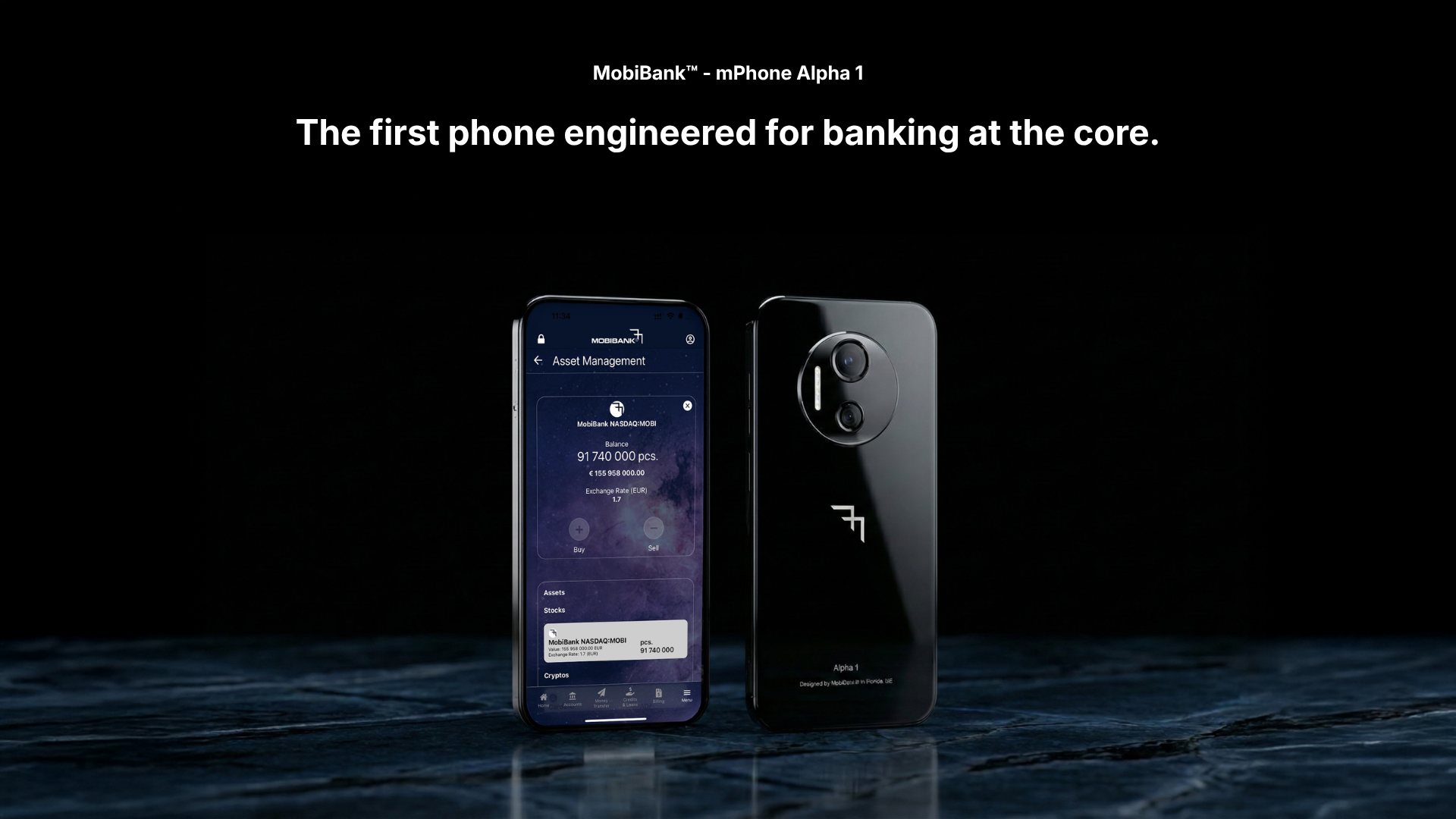
The $85 Alpha 1 is MobiBank's answer to this problem. Not a cheap version of a consumer smartphone with a banking app bolted on. A purpose-built banking device, priced at the point where it functions as a first device rather than an accessory - and designed to work where no app-only bank can follow.
900 Million People Have a Phone. Just Not the Right One.
The World Bank's Global Findex 2025 report contains a number that most fintech conversations ignore. Around 900 million adults who currently lack a financial account own a mobile phone - including 530 million who own a smartphone. The gap between them and full financial access is not a device gap in absolute terms. It is a device gap in capability terms.
The smartphones those 530 million people own are often low-end, running minimal storage, with data plans they can barely afford. Most banking apps require a reasonably modern Android device with a reliable data connection. The overlap between "has a smartphone" and "has a smartphone capable of running a banking app reliably with a data plan" is smaller than the headline number suggests.
For the remaining 400 million who don't own any mobile phone, the World Bank is direct about the cause: cost of the device is cited as the primary barrier. Not network availability. Not literacy. Not trust. The device itself is unaffordable.
This is the problem a purpose-built $85 banking device is designed to solve. Not by cutting corners on a consumer smartphone - but by eliminating every component that isn't essential to banking, and investing in the components that are.
What $85 Actually Buys - and What It Deliberately Doesn't
The Alpha 1 is not a budget phone. The distinction matters. A budget phone is a consumer smartphone with features removed to hit a price point. The Alpha 1 is a banking device engineered from the ground up around a single function - and priced at what that function actually requires, without the overhead of entertainment hardware, camera systems, or consumer OS licensing costs.
Consumer device pricing: publicly available retail data, Q1 2026. Alpha 1: MobiBank® product specification.
At $85, the Alpha 1 sits above the cheapest basic handsets - but those handsets cannot run a banking OS, process secure transactions, or hold a cryptographic ledger on-device. The price point reflects a deliberate engineering choice: include what banking requires, nothing more.
A dedicated secure element - a tamper-resistant chip that cryptographically signs every transaction, preventing the local ledger from being altered or spoofed. Hardware-level encryption across the device's storage. A financial OS that processes transactions without a live internet connection. None of these components exist on a generic entry-level handset. They are the reason the Alpha 1 costs more than the cheapest phones on the market - and the reason it can do what those phones cannot.
Why $85 Changes Who the Market Actually Is
Every financial inclusion analysis that uses smartphone penetration as a ceiling for mobile banking potential is asking the wrong question. Smartphone penetration tells you how many people could theoretically use an app-only bank today. It does not tell you how many people could use a banking device if one existed at the right price point.
Those are very different numbers. And the gap between them is the market that $85 opens.
"The total addressable market for mobile banking is not 'people with smartphones and data plans.' At $85, it becomes 'people with $85 and a need to transact.' That is a fundamentally different - and much larger - number."MobiBank® - Investment Thesis, 2026
Consider Nigeria alone. The country has 38 million unbanked adults. Smartphone penetration is growing - but most of the smartphones reaching first-time buyers are entry-level Android Go devices running on minimal data plans. A full-featured banking app on an underpowered device with intermittent connectivity is not a reliable financial tool. An offline-first banking device at $85, pre-installed with a financial OS that works without internet, is.
The same logic applies across Sub-Saharan Africa, rural South Asia, and any market where connectivity is unreliable and device affordability is a genuine constraint. In these markets, the ceiling for financial inclusion is not the smartphone penetration rate. It is the $85 price point - and whether a banking device exists below it.
How the Alpha 1 Reaches the Market
Pricing a device correctly is only half the challenge. The other half is getting it into hands. MobiBank's distribution strategy is built around two channels that bypass the traditional retail and banking touchpoints that have historically excluded low-income populations.
-
Pre-installation on existing $85 smartphone distribution
MobiBank has secured a US distribution agreement for pre-installation on $85 smartphones - meaning the banking OS arrives on the device at the point of first purchase, without requiring the user to find, download, or configure a banking app. The bank comes with the phone. This is the same model Nokia used to achieve global distribution scale in the 1990s - and it removes the single biggest drop-off point in app-based banking adoption.
-
Direct deployment through national financial inclusion programmes
MobiBank's $10M Letter of Intent in Nigeria is structured as a deployment agreement, not a consumer launch. Governments and financial regulators across Sub-Saharan Africa have made financial inclusion a stated policy priority, and they are actively seeking banking infrastructure that can reach rural populations without requiring broadband connectivity. A purpose-built offline-first device at $85 is a policy solution, not just a consumer product - and that opens procurement and partnership channels unavailable to app-only competitors.
-
GCC expansion through existing mobile distribution networks
The Gulf Cooperation Council markets present a different but complementary opportunity - significant migrant worker populations with high remittance activity and limited access to formal banking relationships. The Alpha 1's offline-capable transaction processing and low cost of entry make it a viable first bank for populations that have historically relied on informal transfer channels charging 8–12% in fees.
Why App-Only Banks Can't Compete Here
Device and pricing data: publicly available retail information, Q1 2026. Alpha 1: MobiBank® specification.
Mobile money platforms like M-Pesa have reached more people at lower device cost - but they operate over USSD, which has fundamental limits on transaction complexity and security. They cannot hold a cryptographic ledger. They cannot process offline transactions with hardware-level fraud prevention. They are a step forward from cash, but not a full banking solution.
The Alpha 1 occupies the gap between them: more capable than a feature phone running USSD, more affordable and accessible than an app-only smartphone bank, and built with security architecture that neither competitor can match at any price point.
What $85 Means for the Unit Economics of Financial Inclusion
For investors, the $85 price point is not just a product decision. It is a unit economics decision that fundamentally changes the financial model of banking at scale in emerging markets.
Traditional financial inclusion analysis calculates cost-to-acquire a new banking customer based on agent network costs, branch infrastructure, or customer acquisition marketing. These costs are high - often higher than the revenue a low-income customer generates in the early years of a banking relationship.
A pre-installed banking device changes this calculation entirely. When the Alpha 1 arrives pre-loaded on a $85 smartphone that a customer was going to buy anyway, the incremental cost of acquiring that banking customer approaches zero. The bank is already on the device. The customer simply activates it.
At scale, this is the most capital-efficient financial inclusion model ever built. And it is only possible because the device exists at $85 - a price point low enough to be included in the base cost of the first smartphone that hundreds of millions of people will ever own.
MobiBank® is the world's first neobank built around a purpose-built banking device - the Alpha 1, priced at $85 and designed as a first device, not an accessory. Proprietary financial OS. Hardware-level encryption. Offline-native transactions. $10M LOI signed for Nigeria deployment. US distribution agreement secured for pre-installation on $85 smartphones. Selected by Mastercard as one of the Top 15 Most Innovative companies globally from 1,500 entrants. Currently raising Series A.
Frequently Asked Questions
What is the cheapest smartphone for banking?
Most banking apps require a mid-range Android smartphone costing $150–$300. The global average smartphone price in 2025 is $370. MobiBank's Alpha 1 is a purpose-built banking device priced at $85 - designed as a first device, not an accessory, making it the most affordable dedicated banking hardware available.
Why does device price matter for financial inclusion?
Device cost is the single biggest barrier to mobile banking adoption that is within a bank's control. Around 900 million adults who are currently unbanked own a mobile phone - but not a smartphone capable of running a banking app reliably. The gap between what they have and what most banking apps require is a hardware gap, not a willingness gap. Closing it requires a device priced within reach of low-income earners.
What is the MobiBank Alpha 1?
The Alpha 1 is MobiBank's purpose-built banking device - a dedicated handset with hardware-level encryption, a secure element chip for transaction signing, and a proprietary financial OS that processes transactions on-device. Priced at $85, it is designed as a first device for markets where smartphone ownership is growing but data plan affordability remains a barrier. It works offline, making it functional in areas with unreliable internet connectivity.
How does an $85 banking device change the market?
At $85, the total addressable market for mobile banking is no longer defined by smartphone penetration - it is defined by a willingness to own a device and a need to transact. Most financial inclusion analysis uses smartphone ownership as a ceiling for mobile banking potential. A purpose-built device at $85 breaks through that ceiling, reaching populations that existing neobanks cannot serve regardless of how good their app is.
What markets is MobiBank targeting with the Alpha 1?
MobiBank's primary deployment markets are Nigeria (where a $10M Letter of Intent has been signed), the broader Sub-Saharan Africa region, the GCC, and the United States, where a distribution agreement has been secured for pre-installation on $85 smartphones. These markets share a common characteristic: large populations of financially excluded adults who have a mobile phone but lack access to reliable banking infrastructure.
The Bank That Fits in a $85 Device
Every financial inclusion strategy that starts with "download our app" has already excluded a significant share of the people it claims to serve. The app assumes the device. The device assumes the data plan. The data plan assumes the connectivity. And connectivity assumes infrastructure that hundreds of millions of people simply don't have.
The $85 Alpha 1 breaks this chain at the first link. It doesn't ask what phone someone already has. It arrives as the phone - or pre-installed on the phone they were already going to buy. Banking comes with it, offline-capable, hardware-secured, and priced at the point where first-time device ownership and first-time banking access happen simultaneously.
That is not a product feature. It is a different theory of how financial inclusion actually happens at scale.
From the MobiBank Insights
Published by MobiBank® (Helsinki, Finland). Sources: World Bank Global Findex 2025, GSMA Mobile for Development, Counterpoint Research Global Smartphone ASP Forecast 2025, ImpactAlpha Mobile Phone Access & Financial Inclusion 2025, Market Data Forecast Africa Smartphone Market 2026. This article is for informational purposes only and does not constitute financial advice or an offer to invest. For investment information, visit mobibank.fi/series-a.