
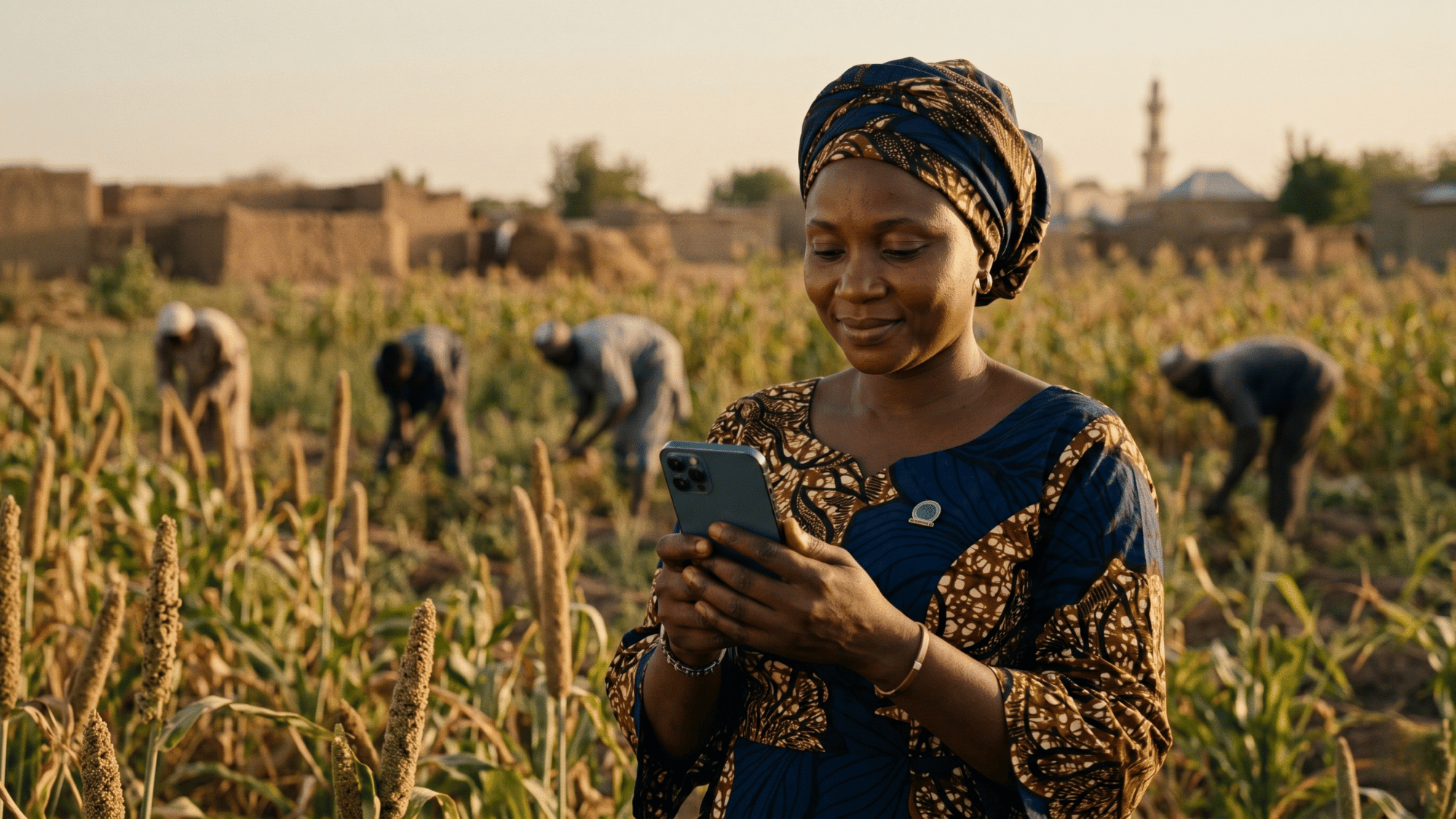
A cooperative leader in Kano State manages the harvest sales for forty-six farmers. She negotiates prices with traders. She coordinates the trucks that come to collect maize. When the rains fail, she is the one who knows which families will struggle to plant the next season. She has been doing this for fifteen years. She has never had a bank account.
This is the story of how MobiBank turns one device in her hand into a banking network for everyone she already serves. And why this model, built around trust that already exists, is the only one that works at scale in markets where Revolut, M-Pesa, and Airtel Money structurally cannot reach.
Six hundred million farmers. Zero banking.
Sub-Saharan Africa has 33 million smallholder farms covering roughly 80% of agricultural land and generating over $300 billion in annual output. Yet more than 70% of these farms operate entirely outside the formal financial system. They cannot access crop insurance. They cannot borrow working capital. They have no way to discover real commodity prices, so they sell through intermediaries who capture 40 to 60% of margin.
The reason is not unwillingness. The reason is infrastructure. There is no branch within a hundred kilometres. There is no ATM. There is no card terminal at the local market. Mobile network coverage drops below 20% in many rural districts, and even where it exists, data is unreliable and expensive. Every banking product designed for a smartphone with reliable internet is, by definition, unavailable to them.
The mobile money paradox.
For the last fifteen years, mobile money has been celebrated as Africa's financial revolution. M-Pesa, Airtel Money, MTN MoMo. The numbers are real: hundreds of millions of users, billions of transactions, transformed urban economies. But for the smallholder farmer, the revolution mostly stopped at the edge of the city.
Mobile money services solved one problem brilliantly, peer-to-peer payments, and never solved the rest. They are not banks. They cannot underwrite a loan against next season's harvest. They cannot offer parametric insurance triggered by satellite weather data. They cannot give a farmer access to commodity prices in Lagos or Accra in real time. And critically, they all require a working mobile network to function.
"Mobile money proved that Africa would adopt digital financial tools at speed. It also proved the limits of what you can do with rented infrastructure on rented networks."MobiBank Engineering Philosophy, 2026
Trust already exists. We just had to build for it.
Every farming community in West, East, and Southern Africa is organised around cooperatives. These are not informal arrangements. They are the structural backbone of rural agriculture, governing harvest sales, group purchasing of seed and fertiliser, collective storage, and increasingly, group savings. Each cooperative has a leader, often elected, almost always trusted, who coordinates between the group and the outside world.
When development banks look at rural Africa they see millions of unbanked individuals. We see something else: a continent of pre-existing trust networks that have been running coordination problems for decades. The cooperative leader is already a node. She already aggregates demand, distributes resources, and manages collective risk. The only thing she has never had is the financial infrastructure to do any of it formally.
Give her one device, and she becomes the bank for everyone she already serves.
One phone. Fifty farmers. Five financial products.
- The cooperative leader receives an Alpha 1.
$85 entry price, subsidised through operator bundle or harvest-cycle micro-credit. Pre-installed via our distribution agreement with a U.S. mobile manufacturer. No app store. No network requirement. No setup friction.
- She onboards her cooperative members.
Each farmer creates an account through her device. Identification is handled by patented four-finger biometric ID. No paperwork. No bank visit. Onboarding takes under three minutes per farmer, fully offline if needed.
- Transactions happen on the device.
Peer-to-peer payments within the cooperative settle locally on the Alpha 1, even with no network. When connectivity returns, the device syncs with MobiBank's core. The patented netless channel covers zero-data zones for non-cooperative members.
- Credit is underwritten by the data the device collects.
Crop yield, transaction history, group repayment behaviour. Harvest-cycle loans of €50 to €500 at 8 to 15%, instead of the 40%+ rates demanded by informal lenders. No third-party credit bureau dependency.
- Insurance, prices, and government rails follow.
Parametric crop insurance, €3 to €8 per season, auto-triggered by satellite weather data. Real-time commodity prices delivered without an internet connection. Government agricultural subsidies disbursed direct to MobiBank accounts, with a contracted fee per transaction.
The unit economics of this model are not incremental. They are categorical. Acquiring a single farmer through retail marketing in rural Nigeria costs roughly $40 to $80 per user, with retention rates that punish app-only banks. Acquiring a cooperative leader costs the same, but reaches twenty to fifty farmers through her trust. Unit economics improve roughly twentyfold.
The hardware moat.
Every neobank you have heard of, Revolut, Monzo, N26, M-Pesa, Airtel Money, processes transactions through remote servers that require a live connection. This is not a feature gap. It is an architectural constraint. You cannot solve it with a software update. You have to build the hardware.
(Revolut, M-Pesa, Airtel)
Alpha 1
This is what we mean by a five-year defensible moat. To match MobiBank's offering, a competitor would need to design proprietary hardware, build a banking-grade operating system, secure global manufacturing distribution, and obtain banking and EMI licenses in target markets. None of these can be acquired through a fundraise alone. They take years.
Where we go, in what order, and why.
Nigeria is the beachhead. 33 million smallholder farms, $40 billion agricultural GDP, and a Central Bank actively mandating financial inclusion. Our LOI is signed. Our initial $2.5 million tranche is deployed. From Nigeria, the rollout follows the natural geography of African agricultural trade corridors.
These projections align with the geography of the AfCFTA digital payments framework, which is collapsing trade and remittance friction across 54 African economies for the first time in history. The cooperative model, layered on top of AfCFTA rails, is how a Pan-African banking network actually gets built. Not through fifty separate market entries, but through one architecture that respects how rural African finance already works.
Defensible moat. ESG-aligned. DFI-eligible.
The agricultural opportunity in Africa is not a marketing story. It is the structural narrative that anchors MobiBank's pre-IPO valuation. €3.21 billion in five-year revenue potential, against a current pre-money valuation of €170 million. A defensible hardware moat that competitors cannot replicate inside the same investment cycle. SDG alignment across goals 1, 2, 8, and 10. Full eligibility for development finance co-investment from the IFC, AfDB, Norfund, and DEG, materially reducing cost of capital relative to standard venture funding.
"Africa's agricultural communities are not waiting for charity. They are waiting for infrastructure that respects how their economies already work."Dr. Mahmoud Alfa · Director Policy & Public Sector, MobiBank Nigeria
The cooperative model is what closes the gap between the $300 billion in agricultural output that already exists across Sub-Saharan Africa, and the formal financial system that has spent fifty years failing to reach it. Every other approach has tried to push services through infrastructure that does not exist. Our approach is to build the infrastructure on top of the social structure that already does.
The cooperative leader in Kano State will receive her Alpha 1 in Q3 2026. She will onboard forty-six farmers in her first month. By the end of the next harvest cycle, she will have processed insurance claims, disbursed micro-credit, and routed government subsidies that previously took six weeks to arrive in her village. She will be running a bank, on behalf of forty-six families who have never had one before.
That is the model. That is the moat. That is the next billion bank accounts.
MobiBank® is the world's first vertically integrated mobile bank, with a proprietary device, OS, and financial platform built in Europe to serve the next billion. Selected by Mastercard as one of the Top 15 Most Innovative companies globally from 1,500 entrants. $10M LOI signed for Nigeria deployment. US distribution agreement secured. Currently raising Series A.
From the MobiBank Insights
Published by MobiBank® (Helsinki, Finland). Sources: World Bank Global Findex 2025, McKinsey Global Institute Financial Inclusion Report, GSMA Mobile Connectivity Index 2025, FAO Smallholder Farms Database, AfCFTA Digital Payments Framework. This article is for informational purposes only and does not constitute financial advice or an offer to invest. For investment information, visit mobibank.fi/series-a.